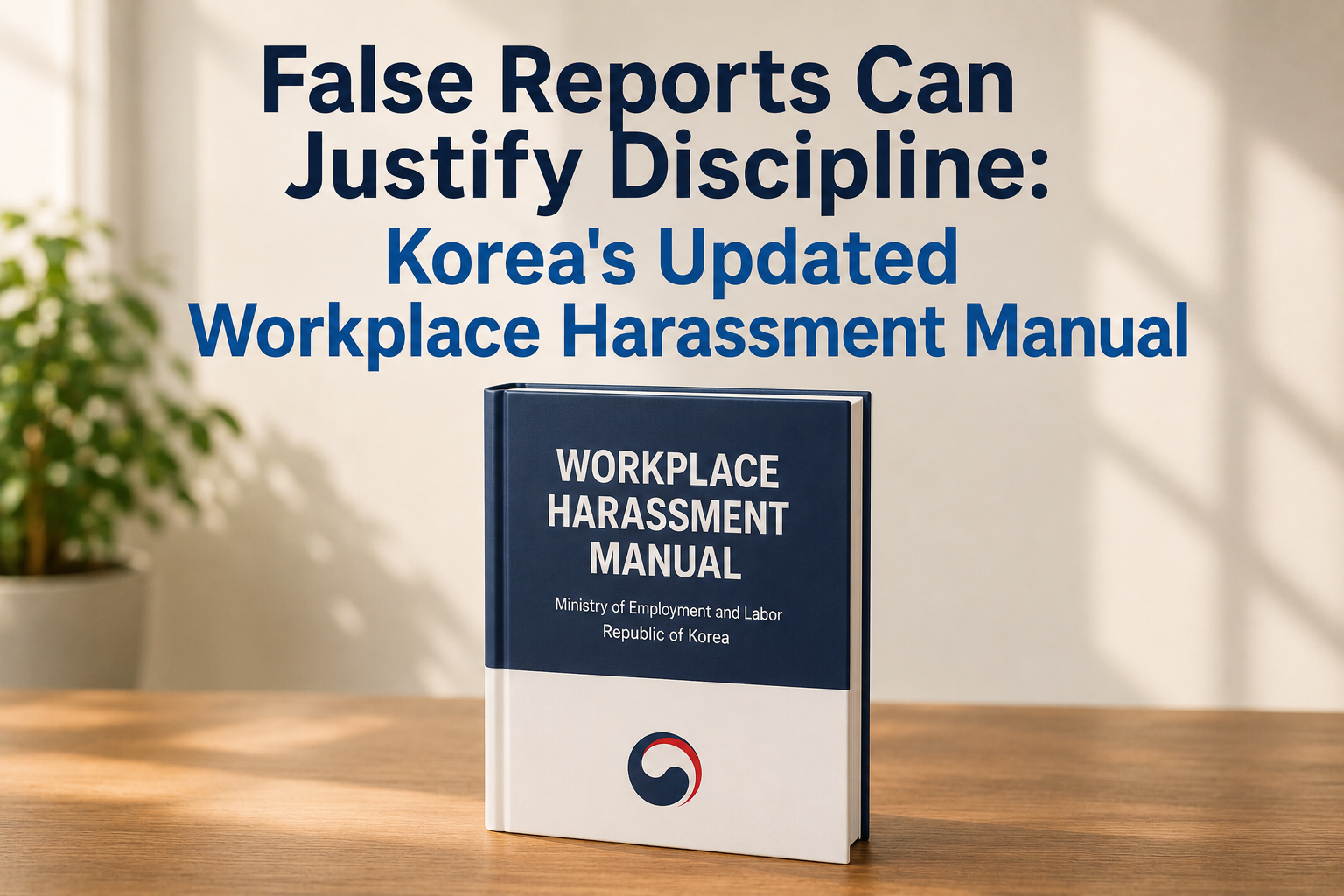
July 2, 2026 - MOEL Updates Workplace Harassment Manual
The Ministry of Employment and Labor (MOEL) has released a revised Workplace Harassment Manual, making the first update in three years.
The Manual covers key aspects of the relevant legislation, including the definition of workplace harassment, determination criteria, employers’ obligations, and prevention and response systems. This version provides more detailed and practical guidance than the previous version.
Above all, the revised Manual extensively incorporates recent judicial precedents, providing clearer criteria and concrete examples to help employers make more objective and consistent assessments in practice.
The two most notable features of the revised Manual are as follows:
1. Repeated or False Reporting as Justifiable Grounds for Disciplinary Action
The manual expressly states that excessive or unfounded false reports can constitute justifiable grounds for disciplinary action.
In practice, many workplaces experience cases where employees repeatedly file complaints over minor interpersonal conflicts or personal grievances, file knowingly false complaints to harm a particular colleague, or submit false allegations in an attempt to obtain favorable personnel actions (e.g., avoiding disciplinary action or securing a transfer). In many cases, however, employers have been reluctant to take decisive action due to their duty to protect complainants, leaving them dragged along by problematic reports.
The revision is meaningful because it clarifies that companies now have a clear legal basis to respond firmly and proactively to the abuse of the reporting system.
2. Preventing “Self-Investigation” and Introducing Recusal Procedures for Investigators
The Manual prevents so-called “self-investigation” in cases where an employer or a representative of the employer (CEO, registered director, general manager, HR/labor manager, plant manager, etc.) is reported as the alleged harasser.
In such cases, the accused individual must be excluded from the investigation process. The Manual recommends establishing a separate framework – such as having the auditor conduct the investigation directly and report to the board of directors, or engaging outside experts or an external organization to carry out the investigation at the company’s expense.
The Manual also requires that complainants must be informed of the overall investigation process. It recommends establishing a recusal procedure so that, where a complainant believes a particular investigator is unlikely to conduct a fair investigation, that person can be excluded upon request. In addition, to ensure fairness and objectivity, the Manual strongly encourages the use of investigation committees and the participation of outside experts.
What Employers Should Take Away
Workplace harassment compliance is no longer simply a matter of receiving complaints and conducting investigations. More than ever, employers need to establish a response system built on fair procedures and objective decision-making standards.
2026. 7. 2. 고용노동부 <직장 내 괴롭힘 매뉴얼> 개정 -- 반복, 허위신고는 정당한 징계사유
고용노동부가 직장 내 괴롭힘 매뉴얼을 3년 만에 개정하여 발표하였습니다. 매뉴얼은 관련 법령의 주요 내용, 직장 내 괴롭힘의 개념과 판단기준, 사용자의 의무, 예방 및 대응체계 등을 담고 있으며, 개정을 통해 기존보다 실무지침이 한층 구체화되었습니다.
무엇보다 이번 개정 매뉴얼은 그동안 축적된 최신 판례를 폭넓게 반영한 것이 특징입니다. 직장 내 괴롭힘의 성립 여부를 판단하는 기준과 구체적인 사례를 상세하게 제시하고 있어, 실무에서 직장 내 괴롭힘 해당 여부를 객관적이고 일관되게 판단하는 데 큰 도움이 될 것으로 기대됩니다.
개정 매뉴얼에서 가장 눈에 띄는 내용은 다음의 두가지 입니다.
1. 과도하거나 근거 없는 허위신고는 정당한 징계사유
'과도하거나 근거 없는 허위신고'는 정당한 징계사유가 될 수 있음을 명시하였습니다.
그동안 사업장에서는 단순한 인간관계 갈등이나 사적인 불만까지 반복적으로 신고하거나, 특정 직원을 무고할 목적으로 허위신고를 하거나, 자신에게 유리한 인사조치(예: 징계회피, 전보)를 얻기 위해 허위신고를 하는 사례가 적지 않았습니다. 그러나 회사는 신고인 보호의무를 의식한 나머지 이러한 신고에 대해서도 적극적으로 대응하지 못하고, 결과적으로 신고에 끌려다니는 경우가 종종 있었습니다.
이번 개정은 제도 남용에 대해서 회사가 보다 명확한 근거를 가지고 적극적으로 대응할 수 있음을 분명히 했다는 점에서 의미가 있습니다.
2. '셀프조사' 방지 및 조사위원 ‘기피, 회피’ 절차
사용자(대표이사, 등기이사, 지배인, 인사노무담당자, 공장장 등)가 괴롭힘 행위자로 신고된 경우 이른바 '셀프조사'를 원칙적으로 방지하도록 하였습니다. 이 경우 해당자를 조사 과정에서 배제해야 하고, 감사가 조사를 직접 실시하고 이사회에 보고하도록 별도 체계를 갖출 것, 회사의 비용으로 외부 전문가 등을 참여시키거나 외부 기관에 의뢰하여 조사를 수행할 것을 제시하고 있습니다.
또한 신고자에게 조사 절차 및 방법 등 조사 전반에 관한 사항을 안내하도록 하였습니다. 신고자가 특정 조사 담당자나 조사위원회 위원이 공정한 조사를 하기 어렵다고 판단하는 경우 기피신청을 통해 제외할 수 있는 절차를 마련할 것을 권고하고 있습니다. 이와 함께 공정성과 객관성을 확보하기 위해 조사위원회 방식이나 외부 전문가의 참여를 적극 권장하고 있습니다.
직장 내 괴롭힘은 이제 단순히 신고를 접수하고 조사하는 수준을 넘어, 공정한 절차와 객관적인 판단기준을 갖춘 대응체계를 마련하는 것이 무엇보다 중요해졌습니다.