Robots at the Gate: Why Hyundai's Union is Demanding Monthly Salaries
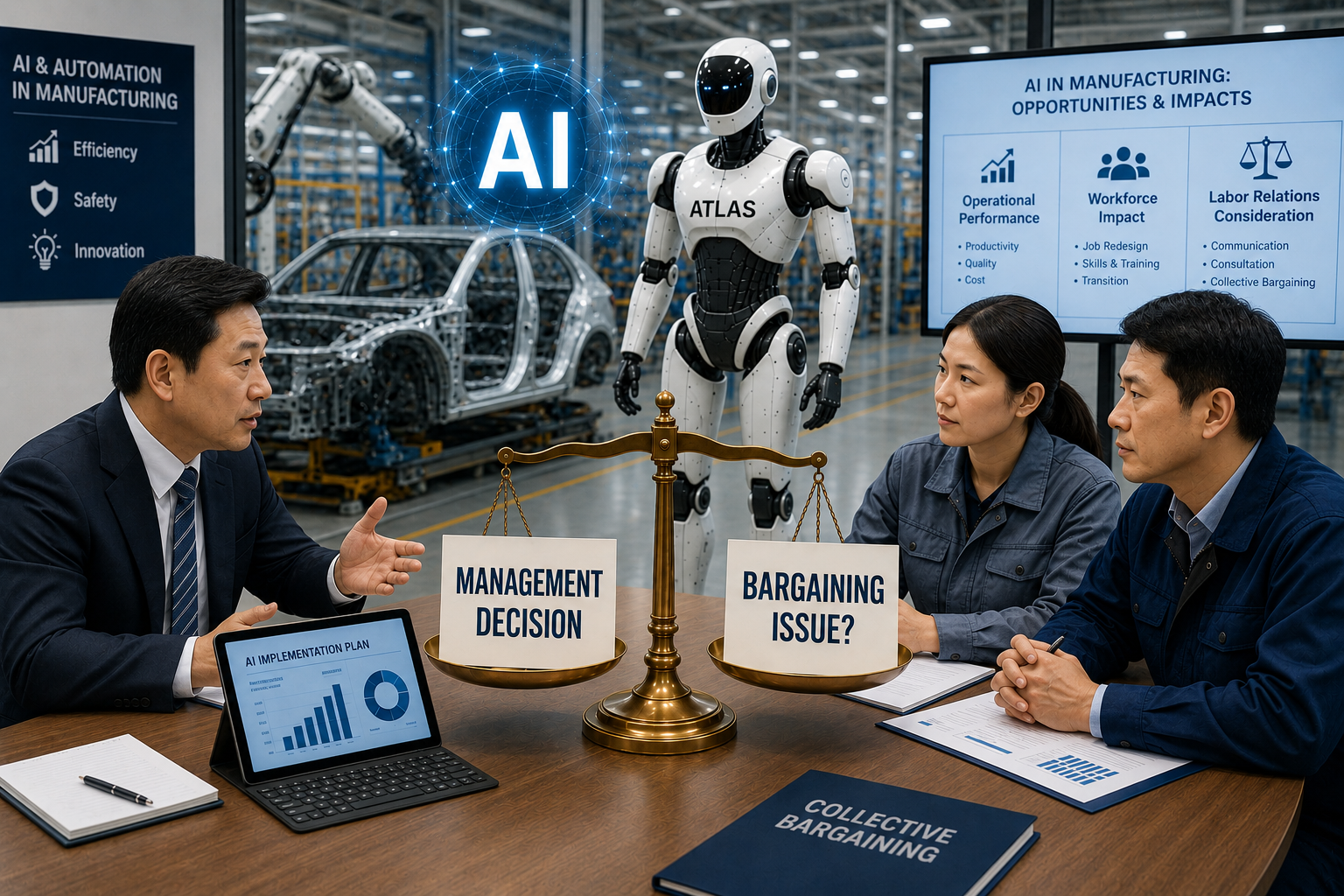
Hyundai Motor’s annual wage negotiations have begun. Among the union’s demands is a call to transition the current hourly-based wage system to a full monthly salary structure. This appears intended to prevent future wage cuts that could result from reduced working hours when AI and robots are deployed in earnest in production sites. The demand also appears to be influenced by Hyundai Motor’s recent announcement of its plan to introduce the humanoid robots ‘Atlas’ to its U.S. plants starting in 2028.
The Question Every Employer Will Soon Face
If a company introduces new technologies such as AI or robots to improve productivity or reduce costs, is it legally required to consult or reach an agreement with the labor union? And if the union demands collective bargaining over such matters, is the employer legally obligated to engage in bargaining?
What the Law Says — And What Changed in 2026
Under Korea’s Trade Union and Labor Relations Adjustment Act, if an employer refuses or neglects collective bargaining without justifiable reasons, such actions may constitute unfair labor practices and may even result in criminal penalties. Accordingly, careful legal review of this issue is highly important.
The amended Act, which took effect on March 10, 2026, expanded the scope of labor disputes from the “determination of working conditions” to “managerial decisions affecting working conditions.” It should be noted, however, that what is meant here is not the managerial decision itself, but rather the matters that, in the course of implementing such decisions, result in substantial and specific changes to employees’ working conditions.
*For more information on the expanded scope of collective bargaining under the amended Act, please see here.
Is AI Adoption Itself a Management Decision?
A company’s decision to introduce new technologies such as AI or robots to improve productivity or reduce costs is fundamentally a management prerogative. Accordingly, labor unions are unlikely to hold direct decision-making power over the adoption or specific methods of implementing such technologies.
But What If Working Conditions Are Affected?
However, the situation may change if the introduction of new technologies has a substantial impact on working conditions. For example, if the reduction or elimination of job roles, changes in working hours, restructuring of wage systems, or changes to health and safety standards are anticipated, a labor union may demand collective bargaining over such matters. If the employer refuses such bargaining demands without justifiable grounds, it could be deemed an unfair labor practice and could potentially result in criminal penalties.
AI Adoption Now Requires More Than Just Technical Decisions
Going forward, companies should not simply dismiss union concerns or bargaining demands on the grounds that the adoption of AI and robots is a matter of managerial judgment. Rather, they should carefully assess in advance the potential impact such technologies may have on employees. As the proliferation of new technologies accelerates, the ability to manage not only the necessity of adoption but also industrial relations risks arising in the process is likely to become a critical competency for businesses.
AI 도입은 경영권일까, 단체교섭 대상일까?
현대자동차의 올해 임금협상이 시작되었습니다. 노조의 요구안에는 현재의 시급제 중심 임금체계를 완전 월급제로 전환해 달라는 내용도 포함되어 있습니다. 이는 향후 인공지능(AI) 및 로봇이 생산 현장에 본격적으로 투입될 경우 근로시간 감소로 인해 임금이 줄어드는 상황을 방지하기 위한 취지로 보입니다. 최근 현대자동차가 2028년부터 미국 공장에 휴머노이드 로봇 ‘아틀라스(Atlas)’를 도입하겠다는 계획을 발표한 점도 이러한 요구의 배경으로 보입니다.
그렇다면 회사가 생산성 향상이나 비용 절감을 위해 AI, 로봇 등 신기술을 도입할 경우 반드시 노조와 협의 또는 합의를 해야 할까요? 또한 노조가 이와 관련된 사항에 대해 단체교섭을 요구하는 경우, 사용자는 반드시 이에 응해야 할까요?
한국의 노동조합 및 노동관계조정법상 사용자가 정당한 이유 없이 단체교섭을 거부하거나 해태할 경우 부당노동행위에 해당할 수 있으며, 형사처벌의 대상이 될 수도 있습니다. 따라서 이 문제에 대한 법적 검토는 매우 중요합니다.
2026년 3월 10일부터 시행된 개정 노조법은 노동쟁의의 대상을 기존의 ‘근로조건의 결정’에서 ‘근로조건에 영향을 미치는 사업경영상의 결정’으로 확대하였습니다. 다만 여기서 의미하는 것은 사업경영상 결정 그 자체가 아니라, 그 결정을 실행하는 과정에서 근로조건에 실질적·구체적인 변동을 초래하는 사항입니다.
회사가 생산성 향상이나 비용 절감을 위해 AI, 로봇 등 신기술을 도입하는 것 자체는 기본적으로 경영권의 영역에 속하며, 그러한 결정은 사용자의 고유한 경영상 판단에 해당할 가능성이 높습니다. 따라서 신기술의 도입 여부나 구체적인 도입 방식 자체에 대해서까지 노조가 직접적인 결정권을 가진다고 보기는 어려울 것입니다.
그러나 신기술 도입으로 인해 근로자들의 근로조건에 실질적인 영향이 발생하는 경우에는 상황이 달라질 수 있습니다. 예를 들어 직무의 축소 또는 소멸, 근로시간의 변경, 임금체계의 개편, 안전보건 기준의 변화 등이 예상된다면, 노조는 이러한 사항에 대해 단체교섭을 요구할 수 있습니다. 그리고 사용자가 정당한 이유 없이 이러한 교섭 요구를 거부할 경우, 부당노동행위로 판단되어 형사처벌의 대상이 될 가능성도 있습니다.
따라서 앞으로 기업들은 AI·로봇 등 신기술의 도입이 단순히 “경영상 판단 사항”이라는 이유만으로 노조의 문제 제기나 교섭 요구를 배제하기보다는, 신기술 도입이 근로자들에게 미치는 영향을 사전에 보다 신중하게 검토할 필요가 있습니다. 향후 신기술의 확산이 가속화될수록, 기업에는 기술 도입 자체의 필요성뿐 아니라 그 과정에서 발생하는 노동법적·노사관계적 리스크를 함께 관리해야 하는 역량이 더욱 중요해질 것으로 보입니다.