A Major Policy Shift: New MOEL Guidelines Announced
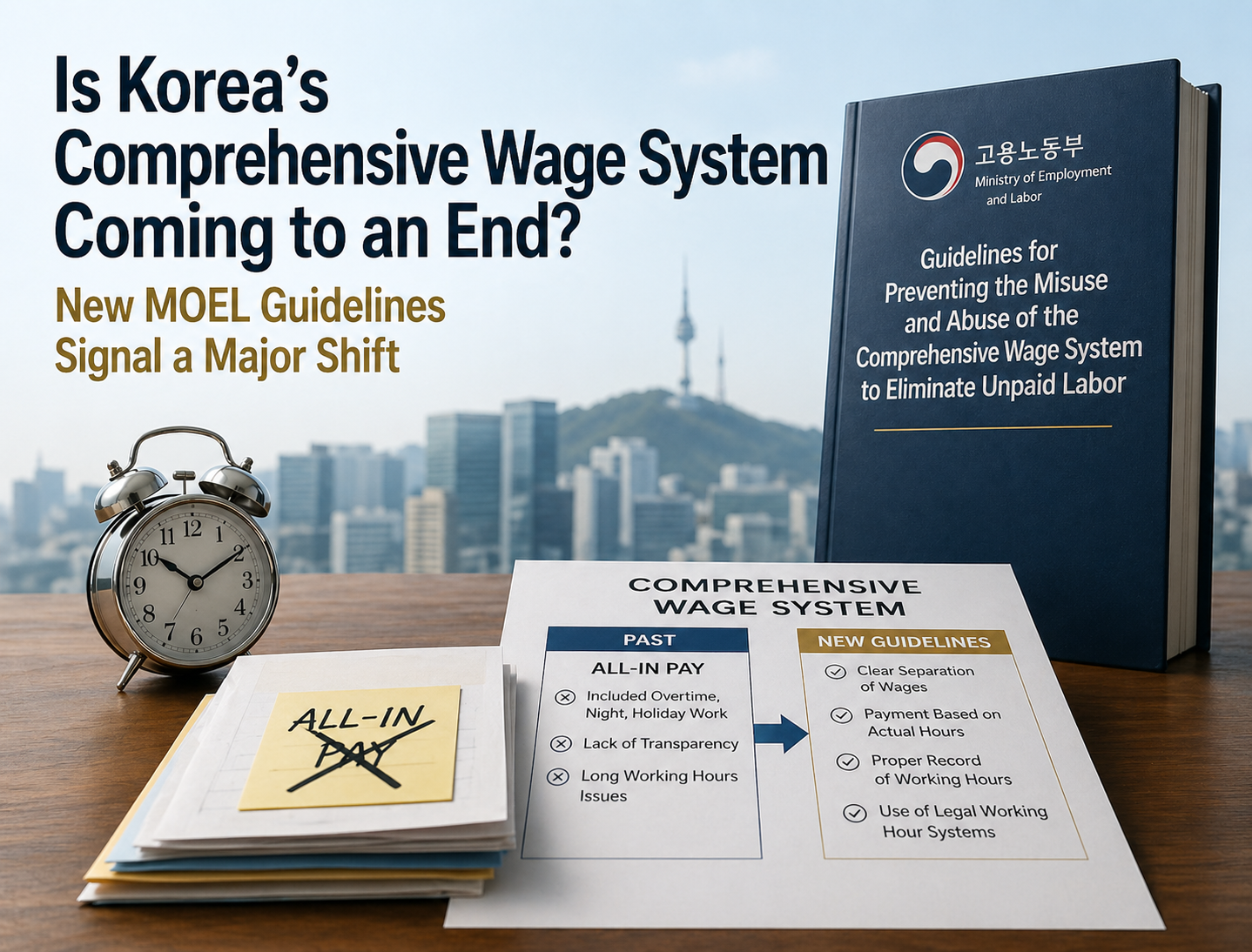
On April 8, 2026, the Ministry of Employment and Labor (MOEL) released new guidelines on the comprehensive wage system (포괄임금제). The official title is “Guidelines for Preventing the Misuse and Abuse of the Comprehensive Wage System to Eliminate Unpaid Labor.”
The issues surrounding this system have been debated for a very long time. While an amendment to the Labor Standards Act is currently underway to address those concerns, the government has issued these guidelines ahead of the legislative changes.
What Is the Comprehensive Wage System?
Under the Labor Standards Act, wages are, in principle, to be paid based on actual working hours. That is, standard working hours are set first, a base salary is determined for those hours, and if work is performed outside those hours – such as overtime, night work, or holiday work – statutory allowances for such work are paid based on the actual hours worked.
The comprehensive wage system, however, is a pay structure under which statutory allowances are deemed to be already included in the base salary, or are paid as a fixed amount regardless of the actual hours worked.
Legally Exceptional, but Widely Used in Practice
This type of wage arrangement is, in principle, invalid; however, court precedents have exceptionally recognized its validity in limited circumstances, such as where it is genuinely difficult to calculate working hours. In practice, however, many companies apply comprehensive wage arrangements based on longstanding custom or on the grounds that employees have consented – even when the strict requirements established by the courts are not met.
The issues – particularly the lack of transparency in wage structures and the prevalence of long working hours – have continued to arise, prompting the government to issue the guidelines.
Key Takeaways from the MOEL Guidelines
The key points of the guidelines are as follows:
1. Clear Separation of Base Salary and Allowances
In accordance with the Labor Standards Act, employers must clearly distinguish the base salary and various allowances in the wage ledger and wage statements. Statutory allowances for overtime, night work, and holiday work must be calculated and paid based on the actual hours worked.
2. No More “All-In” Pay Structures
Employers must not adopt practices where the base salary and statutory allowances are not distinguished, or where a fixed amount covers overtime, night work, and holiday work without distinguishing between them.
3. Fixed Overtime – Shortfalls Must Be Paid
Even in cases of a so-called “Fixed Overtime (Fixed OT)” arrangements*, if the agreed amount is less than what is owed based on actual working hours, the employer must pay the difference.
*A “fixed overtime (Fixed OT)” arrangement refers to a system under which a set number of overtime hours is agreed in advance and corresponding overtime allowances are paid accordingly.
4. Use of Legally Recognized Working Hour Systems Is Required
In workplaces where it is difficult to calculate working hours, employers should instead utilize systems provided under the Labor Standards Act, such as the “deemed working hours system for work performed outside the workplace” or the “discretionary working hours system.”
5. Working Hours Must Be Properly Recorded
Employers must record and manage the working hours of individual employees, including all overtime, night work, and holiday work.
What Changes Now: A Shift in MOEL’s Approach
In practice, employees file wage claims with the MOEL to challenge the validity of the comprehensive wage system and to seek proper overtime pay. However, since determining its validity involves highly complex factual assessments, labor inspectors have faced limitations in processing these cases.
With the issuance of these new guidelines, however, it is expected that the MOEL will, in principle, no longer recognize the validity of the comprehensive wage system and wage claims are likely to be handled on that basis.
In that case, payments previously treated as covering overtime may be disregarded entirely, exposing employers to substantial back pay obligations.
Taking Action: How Your Company Should Prepare
Accordingly, companies currently operating under a comprehensive wage system should consider promptly abolishing the system and restructuring their wage framework, or alternatively adopting legally recognized frameworks such as the “deemed working hours system” or the “discretionary working hours system.” Another option may be to enter into so-called “fixed overtime (fixed OT)” arrangements with individual employees.
If you require legal advice or consulting to navigate these changes and ensure compliance, please feel free to contact us at any time.
포괄임금제 변화 - 고용노동부 지침의 의미와 영향
2026. 4. 8. 고용노동부가 “공짜노동 근절을 위한 포괄임금 오남용 방지 지도 지침”을 발표했습니다. 포괄임금제도의 문제점은 아주 오랫동안 논의되어 왔습니다. 이를 위해 현재 근로기준법 개정이 추진 중인데 법 개정 전에 정부가 지침을 먼저 내놓은 것입니다.
임금은 원래 근로기준법상 근로시간에 따라 지급하는 것이 원칙입니다. 소정근로시간을 먼저 정하고 이에 대한 기본급을 정한 뒤, 만약 소정근로시간 외의 근로 – 즉 연장∙야간∙휴일근로가 발생하면 이에 대한 법정수당을 실제 근무한 근로시간을 기준으로 지급하는 것입니다.
그런데 포괄임금제도란 이러한 법정수당을 실제 근로시간에 상관없이 기본급에 모두 포함되어 있다고 하거나, 몇 시간을 근로하든 상관 없이 일정액을 법정수당으로 지급하는 방식을 말합니다.
이러한 지급방식은 원칙적으로는 무효이나 그동안 판례를 통해 “근로시간 산정이 어려운 경우" 등에 한해 예외적으로 효력이 인정되어왔습니다. 그러나 실무적으로는 판례에서 제시하는 엄격한 요건을 충족하지 못하면서도, 적지 않은 회사들이 오랜 관행으로 또는 직원이 동의했다는 이유로 포괄임금제를 적용해오고 있습니다.
정부 지침의 주요 내용을 정리하면 다음과 같습니다.
- 사용자는 근로기준법에 따라 임금대장과 임금명세서에 기본급과 각종 수당을 구분하여 기재해야 한다. 실제 근로한 시간에 상응하는 연장∙야간∙휴일근로수당을 산정하여 지급해야 한다.
- 기본급과 법정수당을 구분하지 않거나(정액급제), 연장∙야간∙휴일근로수당을 서로 구분하지 않고 일정액으로 지급(정액수당제)하여서는 아니된다.
- 현장에서 활용되고 있는 이른바 ‘고정OT 약정’을 체결한 경우에도 그 금액이 실제 근로시간에 비해 적을 때는 반드시 그 차액을 지급해야 한다.
- 만약 근로시간 산정이 어려운 사업장의 경우에는 근로기준법에서 정한 “사업장 밖 간주근로시간제” 또는 “재량근로시간제” 등을 활용하도록 해야 한다.
- 개별 근로자의 연장근로, 야간근로, 휴일근로를 포함한 근로시간을 기록, 관리해야 한다.
실무적으로 가장 중요한 의미를 갖는 것은 고용노동부가 앞으로 근로감독 및 임금체불 진정 사건 처리 시 포괄임금제의 유효성을 원칙적으로 인정하지 않을 가능성이 높다는 것입니다. 이 경우 포괄임금으로 지급된 연장∙야간∙휴일근로수당 금액이 모두 인정되지 않으면서 그 결과 사용자는 상당한 규모의 추가 임금 지급 의무를 부담하게 될 수 있습니다.
이에 따라 현재 포괄임금제를 적용하고 있는 회사는 포괄임금제 폐지 및 임금체계 개편, ‘사업장 밖 간주근로시간제’ 또는 ‘재량근로시간제’ 등의 도입, 개별 근로자들과 ‘고정 OT 약정’ 체결 등의 조치를 취해야 할 것으로 보입니다.


A Major Policy Shift: New MOEL Guidelines Announced
On April 8, 2026, the Ministry of Employment and Labor (MOEL) released new guidelines on the comprehensive wage system (포괄임금제). The official title is “Guidelines for Preventing the Misuse and Abuse of the Comprehensive Wage System to Eliminate Unpaid Labor.”
The issues surrounding this system have been debated for a very long time. While an amendment to the Labor Standards Act is currently underway to address those concerns, the government has issued these guidelines ahead of the legislative changes.
What Is the Comprehensive Wage System?
Under the Labor Standards Act, wages are, in principle, to be paid based on actual working hours. That is, standard working hours are set first, a base salary is determined for those hours, and if work is performed outside those hours – such as overtime, night work, or holiday work – statutory allowances for such work are paid based on the actual hours worked.
The comprehensive wage system, however, is a pay structure under which statutory allowances are deemed to be already included in the base salary, or are paid as a fixed amount regardless of the actual hours worked.
Legally Exceptional, but Widely Used in Practice
This type of wage arrangement is, in principle, invalid; however, court precedents have exceptionally recognized its validity in limited circumstances, such as where it is genuinely difficult to calculate working hours. In practice, however, many companies apply comprehensive wage arrangements based on longstanding custom or on the grounds that employees have consented – even when the strict requirements established by the courts are not met.
The issues – particularly the lack of transparency in wage structures and the prevalence of long working hours – have continued to arise, prompting the government to issue the guidelines.
Key Takeaways from the MOEL Guidelines
The key points of the guidelines are as follows:
1. Clear Separation of Base Salary and Allowances
In accordance with the Labor Standards Act, employers must clearly distinguish the base salary and various allowances in the wage ledger and wage statements. Statutory allowances for overtime, night work, and holiday work must be calculated and paid based on the actual hours worked.
2. No More “All-In” Pay Structures
Employers must not adopt practices where the base salary and statutory allowances are not distinguished, or where a fixed amount covers overtime, night work, and holiday work without distinguishing between them.
3. Fixed Overtime – Shortfalls Must Be Paid
Even in cases of a so-called “Fixed Overtime (Fixed OT)” arrangements*, if the agreed amount is less than what is owed based on actual working hours, the employer must pay the difference.
*A “fixed overtime (Fixed OT)” arrangement refers to a system under which a set number of overtime hours is agreed in advance and corresponding overtime allowances are paid accordingly.
4. Use of Legally Recognized Working Hour Systems Is Required
In workplaces where it is difficult to calculate working hours, employers should instead utilize systems provided under the Labor Standards Act, such as the “deemed working hours system for work performed outside the workplace” or the “discretionary working hours system.”
5. Working Hours Must Be Properly Recorded
Employers must record and manage the working hours of individual employees, including all overtime, night work, and holiday work.
What Changes Now: A Shift in MOEL’s Approach
In practice, employees file wage claims with the MOEL to challenge the validity of the comprehensive wage system and to seek proper overtime pay. However, since determining its validity involves highly complex factual assessments, labor inspectors have faced limitations in processing these cases.
With the issuance of these new guidelines, however, it is expected that the MOEL will, in principle, no longer recognize the validity of the comprehensive wage system and wage claims are likely to be handled on that basis.
In that case, payments previously treated as covering overtime may be disregarded entirely, exposing employers to substantial back pay obligations.
Taking Action: How Your Company Should Prepare
Accordingly, companies currently operating under a comprehensive wage system should consider promptly abolishing the system and restructuring their wage framework, or alternatively adopting legally recognized frameworks such as the “deemed working hours system” or the “discretionary working hours system.” Another option may be to enter into so-called “fixed overtime (fixed OT)” arrangements with individual employees.
If you require legal advice or consulting to navigate these changes and ensure compliance, please feel free to contact us at any time.
포괄임금제 변화 - 고용노동부 지침의 의미와 영향
2026. 4. 8. 고용노동부가 “공짜노동 근절을 위한 포괄임금 오남용 방지 지도 지침”을 발표했습니다. 포괄임금제도의 문제점은 아주 오랫동안 논의되어 왔습니다. 이를 위해 현재 근로기준법 개정이 추진 중인데 법 개정 전에 정부가 지침을 먼저 내놓은 것입니다.
임금은 원래 근로기준법상 근로시간에 따라 지급하는 것이 원칙입니다. 소정근로시간을 먼저 정하고 이에 대한 기본급을 정한 뒤, 만약 소정근로시간 외의 근로 – 즉 연장∙야간∙휴일근로가 발생하면 이에 대한 법정수당을 실제 근무한 근로시간을 기준으로 지급하는 것입니다.
그런데 포괄임금제도란 이러한 법정수당을 실제 근로시간에 상관없이 기본급에 모두 포함되어 있다고 하거나, 몇 시간을 근로하든 상관 없이 일정액을 법정수당으로 지급하는 방식을 말합니다.
이러한 지급방식은 원칙적으로는 무효이나 그동안 판례를 통해 “근로시간 산정이 어려운 경우" 등에 한해 예외적으로 효력이 인정되어왔습니다. 그러나 실무적으로는 판례에서 제시하는 엄격한 요건을 충족하지 못하면서도, 적지 않은 회사들이 오랜 관행으로 또는 직원이 동의했다는 이유로 포괄임금제를 적용해오고 있습니다.
정부 지침의 주요 내용을 정리하면 다음과 같습니다.
실무적으로 가장 중요한 의미를 갖는 것은 고용노동부가 앞으로 근로감독 및 임금체불 진정 사건 처리 시 포괄임금제의 유효성을 원칙적으로 인정하지 않을 가능성이 높다는 것입니다. 이 경우 포괄임금으로 지급된 연장∙야간∙휴일근로수당 금액이 모두 인정되지 않으면서 그 결과 사용자는 상당한 규모의 추가 임금 지급 의무를 부담하게 될 수 있습니다.
이에 따라 현재 포괄임금제를 적용하고 있는 회사는 포괄임금제 폐지 및 임금체계 개편, ‘사업장 밖 간주근로시간제’ 또는 ‘재량근로시간제’ 등의 도입, 개별 근로자들과 ‘고정 OT 약정’ 체결 등의 조치를 취해야 할 것으로 보입니다.